




Historian's route
1 tickets€29
Source: Prof. Dr. İlber Ortaylı (1947–2026)
İlber Ortaylı's Istanbul walk, in two days
1 ticketed stopsOpen the route
From Karaköy to Dolmabahçe, the first kilometres of the Bosphorus's European shore: the underground Yeraltı Mosque, Sinan's Kılıç Ali Pasha Complex, the Tophane fountain and cannon foundry, the Nusretiye Mosque, Molla Çelebi at Fındıklı, the Dolmabahçe Mosque and Dolmabahçe Palace. We compiled it from the twenty-first walk in Hilary Sumner-Boyd and John Freely's book Strolling Through Istanbul (1972); we added the timings, breaks and practical notes.
This route was compiled by AnatoliaPass editors from the published recommendations of the person named; the timings, breaks and practical notes are ours. It does not mean that the person recommends or endorses AnatoliaPass.
Hilary Sumner-Boyd was born in New York in 1913 and educated there and in England; he spent most of his life in Istanbul, teaching at Robert College, and died in the city on 2 September 1976. John Freely was born in Brooklyn in 1926; a physicist, he came to Istanbul in 1960 to teach at Robert College and over his lifetime wrote dozens of books on Istanbul, the Ottomans and the history of science; he died in 2017. Strolling Through Istanbul, which the two wrote together, was published in Istanbul by Redhouse Press in 1972 and is still in print today in revised editions.
The book covers the Bosphorus in two chapters: first the European shore just north of Galata, then the whole of the Bosphorus. This route follows the first. The shore from Karaköy to Dolmabahçe was for centuries a shore of shipyards, cannon foundries, piers and, in the end, palaces.
Tophane takes its name from the imperial foundry where cannon were cast from the time of Mehmed the Conqueror. The mosque of Grand Admiral Kılıç Ali Pasha was built at the water's edge; after abolishing the Janissary corps, Mahmud II gave his new mosque beside the artillery barracks the name Nusretiye, meaning 'victory'. Sumner-Boyd and Freely line up these stops one after another along the shore.
Dolmabahçe, as its name suggests, is a bay that was filled in and turned into a garden in the 17th century. Here Abdülmecid built his new palace between 1843 and 1856; the book describes Dolmabahçe as the largest and most magnificent of the palaces. The walk ends at the palace gate; tour the interior if you like, then return by ferry from Beşiktaş pier.
Start: Karaköy pier; along the shore past the pier, turn left, then left again, ≈ 5 min · stay 20 min
The book starts the Bosphorus-shore walk underground: a low, vaulted cellar in Karaköy, converted into a mosque in the 1750s. The cellar is thought to have been part of the Galata castle to which, in Byzantine times, the chain closing the mouth of the Golden Horn was fastened. Inside, visitors pay their respects at graves attributed to two Companions of the Prophet believed to have died here during the Arab sieges.

Visits pause during prayer times; enter quietly. Check the times before you go.
Along Kemeraltı Caddesi to Tophane ≈ 8 min · stay 30 min
The complex Mimar Sinan built in his nineties for Grand Admiral Kılıç Ali Pasha; the mosque was finished in 1580 and is like a small-scale interpretation of the plan of Hagia Sophia. The mosque once stood on the seashore; the reclaimed land in front of it is now home to Galataport. The complex's hamam has been restored and reopened.

Visits pause during prayer times; check the times before you go.
Opposite the mosque, ≈ 2 min · stay 20 min
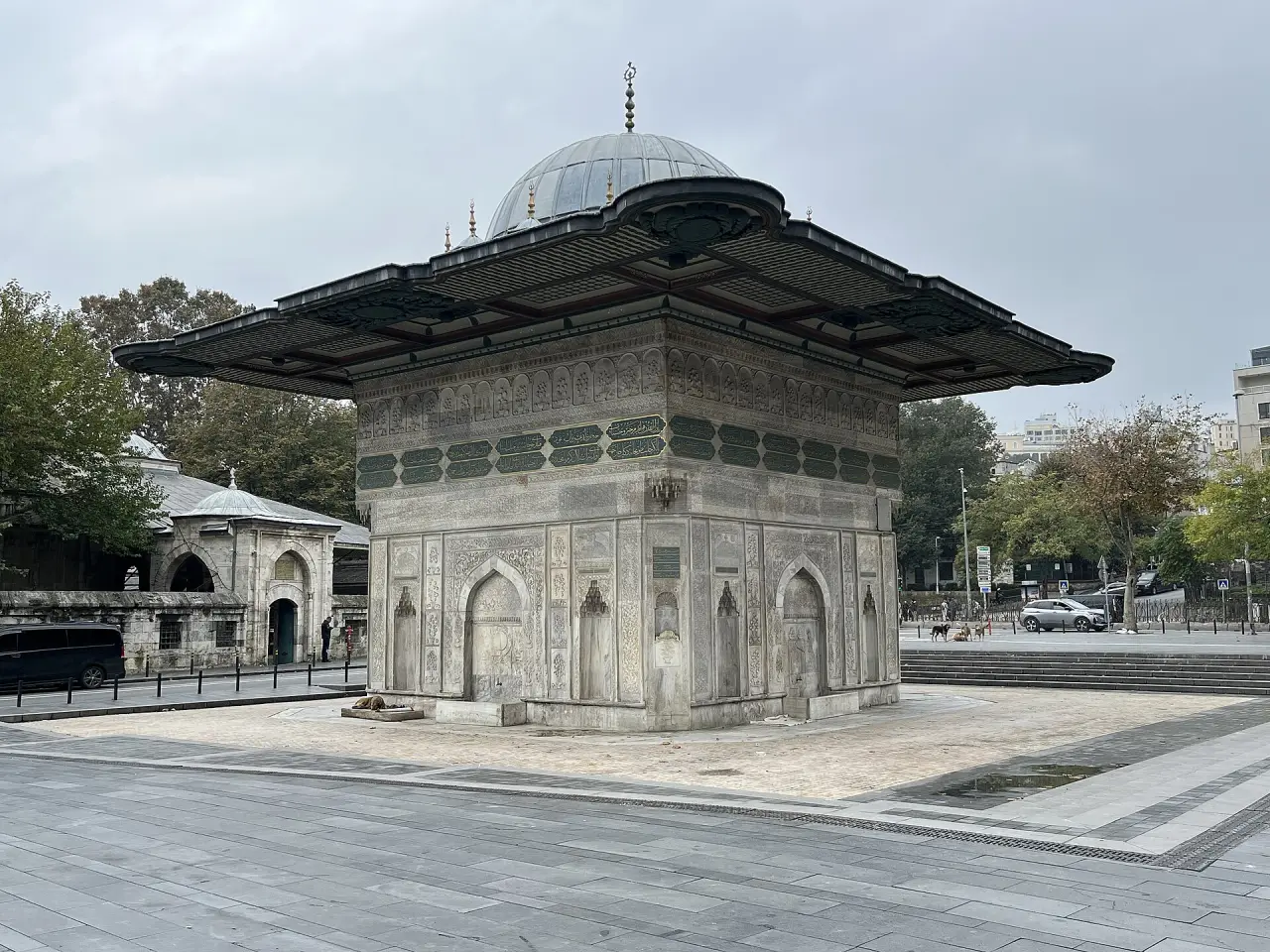
The square fountain built by Mahmud I in 1732; its four faces covered in marble reliefs, it is one of the first examples of Ottoman Baroque. The long domed building behind it is the Tophane-i Amire: the imperial foundry that gave the district its name, as cannon were cast here from the time of Mehmed the Conqueror; today it is a university's culture and arts centre.
Exhibition days at the Tophane-i Amire vary; check before you go.
≈ 3 min, towards the shore · stay 30 min
The mosque Mahmud II had Kirkor Balyan build in 1823–1826; after the abolition of the Janissary corps it was given the name Nusretiye, meaning 'victory'. With its slender minarets and Empire-style decoration, it is an example of the transition from Ottoman Baroque to Western styles.

Visits pause during prayer times; check the times before you go.
Along Meclis-i Mebusan Caddesi to Fındıklı ≈ 12 min · stay 20 min
The building the book calls the little Sinan mosque at Fındıklı: it was built in the mid-16th century for the chief judge (kazasker) Mehmed Vusûlî Efendi, better known as Molla Çelebi. Its dome resting on a hexagonal system of supports is one of the plans Sinan tried out on a small scale. It stands on the shore, with a university building and Fındıklı Park beside it; for lunch, carry on towards Kabataş.

Visits pause during prayer times; check the times before you go.
≈ 10 min, past Kabataş · stay 20 min
The mosque begun by Bezmiâlem Valide Sultan and completed after her death by her son Abdülmecid in 1855; its architect was Garabet Balyan. With its large-windowed stone arches and slender minarets on the shore, it was conceived as the ceremonial mosque beside the palace. Road widening took away its courtyard and sebil.

Visits pause during prayer times; check the times before you go.
Past the Clock Tower to the palace gate ≈ 5 min · stay 120 min
The palace Abdülmecid built between 1843 and 1856 on the filled-in garden on the Bosphorus shore; the book describes it as the largest and most magnificent of the palaces. The Selamlık and the Harem are visited as separate sections; the Ceremonial Hall and the staircase with its crystal balustrade are its best-known corners. Atatürk died in this palace on 10 November 1938.

The National Palaces are usually closed on Mondays; check tickets, hours and sections before you go.
≈ 2 h 15 min · fast ferry + bus · Day trip
Why here: The first Ottoman capital. The Green Mosque, the Grand Mosque and Koza Han make an easy day trip; we suggest it if you are staying in Istanbul for more than four days. Not part of this route.
Travellers who check in on this route can rate it. No one else can.
Be one of the first travellers to walk this route. If you have a question or a tip, share it with the community.
After walking the route you can rate it using the check-in in the app. Reviews go live after a short check.
Source: Prof. Dr. İlber Ortaylı (1947–2026)
Source: Prof. Dr. İlber Ortaylı (1947–2026)
Your basket stays saved on this device, so you can pick up where you left off once sales open. Until then, routes, the map and audio guides are free.