




Historian's route
1 tickets€29
Source: Prof. Dr. İlber Ortaylı (1947–2026)
İlber Ortaylı's Istanbul walk, in two days
1 ticketed stopsOpen the route
Ephesus is one of Christianity's oldest places of pilgrimage, and the House of the Virgin Mary on Bülbüldağı is a small stone house where Christians and Muslims alike come to pray today. Start the morning on Ayasuluk Hill, at the basilica built, according to tradition, over the tomb of John the Apostle, and at the İsa Bey Mosque; see the Cave of the Seven Sleepers and the Church of Mary, where the council of 431 met, walk the marble streets of Ephesus and end the day at the house on the mountainside. The last section is a steep climb: most visitors take a taxi up from the upper gate of Ephesus.
According to Christian tradition, Jesus on the cross entrusted his mother Mary to his disciple John. A belief that took hold in later centuries holds that John came to Ephesus and that Mary lived here with him. There is also a place in Jerusalem revered as Mary's tomb; the two traditions have coexisted for centuries and are debated among the churches too.
Even so, Ephesus's link with Mary is an old one: the Council of Ephesus, which met in 431, accepted for Mary the title Theotokos, meaning "God-bearer". The council met in the church named after Mary, which you can visit today inside the archaeological site.
Anne Catherine Emmerich (1774–1824), an Augustinian nun who spent years bedridden in Germany, became known for visions in which she said she had seen the house where Mary spent her last years. The writer Clemens Brentano recorded what she described; the book was published in Munich in 1852, after Emmerich's death. It placed the house on a hilltop near Ephesus, overlooking the sea.
Using this description, the French priest Julien Gouyet announced that he had found the remains of a building on Bülbüldağı on 18 October 1881; he was not taken very seriously. Ten years later, at the urging of the nun Marie de Mandat-Grancey, two Lazarist priests from İzmir, Henri Jung and Eugène Poulin, set out to investigate and found the ruin again on 29 July 1891. According to sources, the Greeks of Şirince knew the place as Panaya Kapulu, meaning "the Virgin's gate", and visited it.
The Catholic Church has never ruled that the house really belonged to Mary; even so, the first pilgrimage was blessed by Pope Leo XIII in 1896. Pope Paul VI visited the house in 1967, John Paul II in 1979 and Benedict XVI in 2006. Every year on 15 August, the day the Assumption of Mary is commemorated, a Mass is held here.
Mary is the only woman mentioned by name in the Quran; the surah that bears her name, Maryam, tells her story and the birth of Jesus. This is why some of those who come to Bülbüldağı are Muslims: some come to pray, some to drink from the fountain, some to leave a note on the wishing wall. Seeing people praying side by side in different languages in the courtyard is an everyday sight here.
This route is not walked to prove any faith's claim, but to see the reverence that has stood side by side on the same hillside for centuries. You can read the last two parts of the story under the trees in front of the house.
Visiting routes walked in Anatolia for centuries: churches, mosques, synagogues, tombs, caves and holy springs held sacred in Christian, Muslim, Jewish and Sufi traditions, plus long-distance cultural routes that follow old pilgrimage and caravan roads. These routes pass no judgement on matters of faith; where something rests on tradition or belief rather than history, we say so. Most of the stops are still places of worship today: dress modestly, don't walk around inside during services, keep quiet and don't photograph people praying.
Start: central Selçuk; ≈ 10 min walk uphill from the İZBAN station · stay 50 min
According to tradition, John the Apostle lived in Ephesus and was buried on this hill. In the 6th century Emperor Justinian built a large, cross-shaped, multi-domed basilica over the spot held to be his tomb; the surviving columns and re-erected walls crown the hill today. Look down from the tomb site in the middle: the İsa Bey Mosque and the single column of the Temple of Artemis share the same view.

The archaeological site is ticketed; check hours and prices before you go. Come in the cool of the morning; there is little shade in summer.
≈ 5 min walk (400 m), at the western foot of the hill · stay 25 min
Commissioned by İsa Bey of the Aydınoğulları from the Damascene architect Ali bin Müşimiş in 1374–75, this mosque is one of the most original buildings of the beylik period. With its courtyard plan, its columns brought from Ephesus and its stonework, it gathers Selçuk's long history into a single building. Stopping here after the basilica means seeing the places of worship of two faiths one after the other on the same hillside.

A working mosque: pause your visit during prayer times, cover your head inside and take off your shoes. It may close from time to time for restoration; check before you go.
≈ 40 min walk (2.8 km) or ≈ 7 min by taxi; on the eastern slope of Panayır Dağı · stay 25 min
The Seven Sleepers in Christian tradition, the Ashab-ı Kehf in Muslim tradition: young men who, it is told, fled persecution for their faith, took refuge in a cave and woke years later. The story is also told in the Quran's Surah al-Kahf. This site in Ephesus, with its rock-cut tombs and the church built over them, has been a place of visitation since Byzantine times. You can also see a cave linked to the same tradition on this collection's Tarsus route.
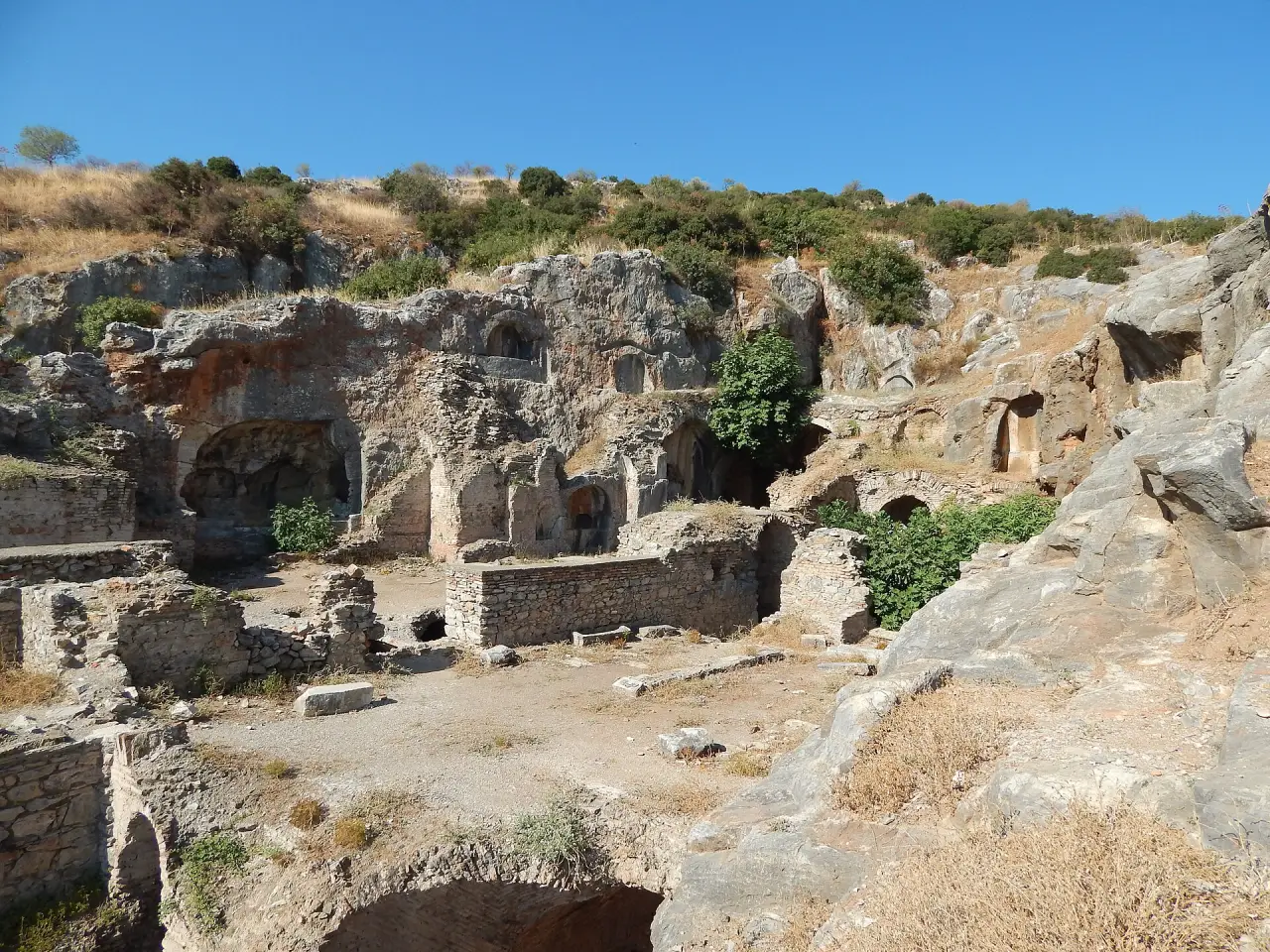
According to 2023 reports, the cave cannot be entered because of conservation and landscaping work and can only be seen from a few metres away. Check the current situation before you go.
≈ 30 min walk (2.4 km) to the lower (harbour) entrance of Ephesus · stay 30 min
Built inside a long Roman-era structure, this church is considered one of the oldest named after Mary. The Council of Ephesus met here in 431 and accepted for Mary the title Theotokos, "God-bearer". Its brick arches and baptistery can still be made out; it is one of the rare quiet corners within busy Ephesus. Read the first part of the story here.

Entry is with the Ephesus site ticket; the church is near the lower entrance. Check entry points and hours before you go.
≈ 12 min walk (900 m) through the archaeological site · stay 90 min
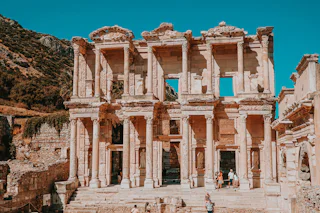
According to the Acts of the Apostles, Paul stayed in Ephesus for more than two years; the Great Theatre, where a crowd stirred up by the silversmiths gathered shouting "Great is Artemis of the Ephesians!", lies on this route. Walk along Marble Street to the Library of Celsus, then up Curetes Street to the upper gate: here you see how the first Christian community grew inside a great pagan city.

Little shade; bring a hat and water. The Terrace Houses need a separate ticket. If you leave by the upper (Magnesian) gate, you take the shortest way to the House of the Virgin Mary. (Photo: Library of Celsus.)
≈ 10 min by taxi from the upper gate of Ephesus; on foot ≈ 5 km with a climb of about 340 m on an unshaded asphalt road · stay 60 min
A small, single-room stone chapel among the trees: the house where, according to Christian belief, Mary spent her last years. Its foundations are thought to be old; its present appearance largely dates from later centuries and from 20th-century repairs. Visitors pass through in turn, drink from the fountain below and leave notes on the wishing wall. Read the last two parts of the story under the trees in the courtyard.
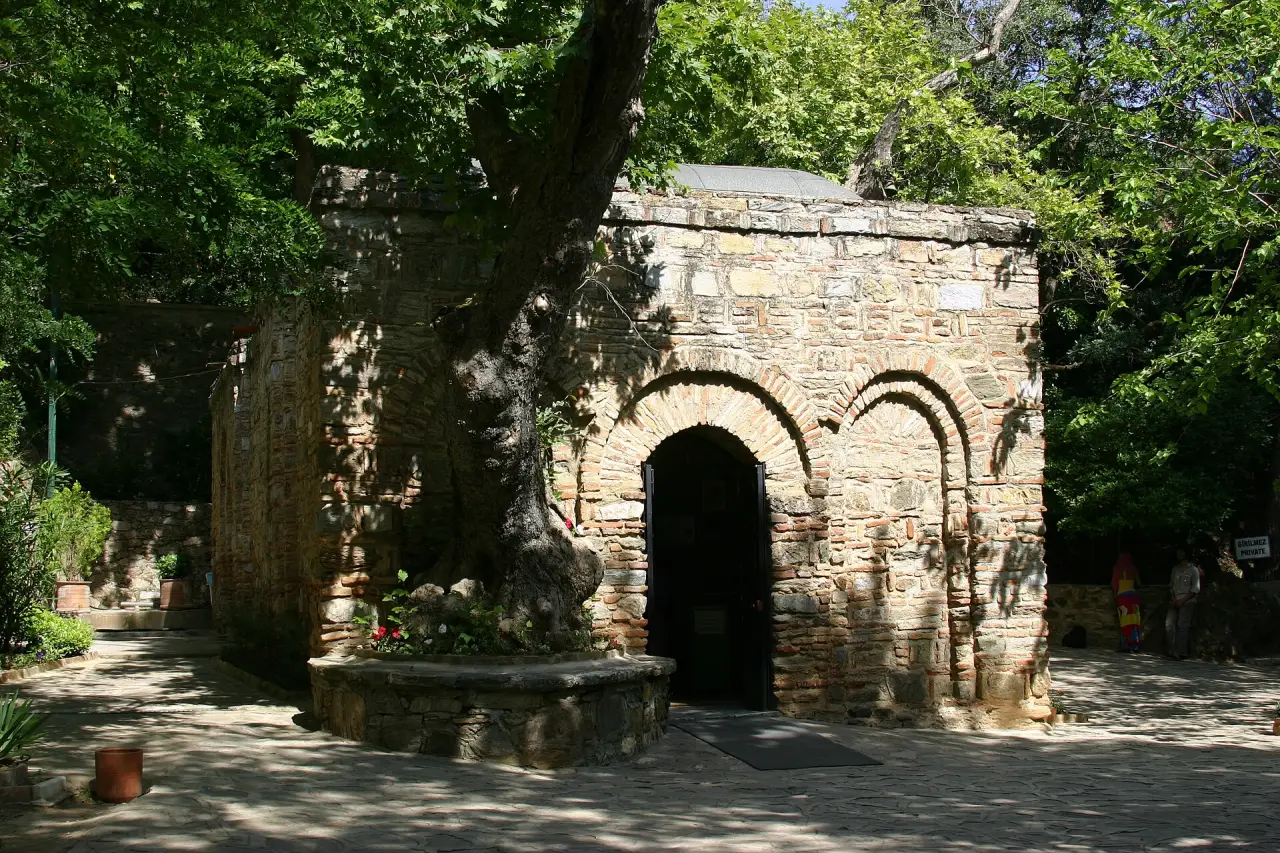
There is an entry fee; check hours and prices before you go. It gets very crowded on 15 August, the day of the Mass. Public transport up the mountain is almost non-existent: arrange a taxi for the return in advance.
≈ 2 h 15 min · fast ferry + bus · Day trip
Why here: The first Ottoman capital. The Green Mosque, the Grand Mosque and Koza Han make an easy day trip; we suggest it if you are staying in Istanbul for more than four days. Not part of this route.
Travellers who check in on this route can rate it. No one else can.
Be one of the first travellers to walk this route. If you have a question or a tip, share it with the community.
After walking the route you can rate it using the check-in in the app. Reviews go live after a short check.
Source: Prof. Dr. İlber Ortaylı (1947–2026)
Source: Prof. Dr. İlber Ortaylı (1947–2026)
