HomeTicketsCity PassDijital rehber

Dijital rehber

Şehir Pass ile gezebileceğin 5 yer: saatler, kapalı günler, giriş ve buluşma noktaları, sesli rehber metinleri. Yazdırabilir ya da PDF olarak kaydedebilirsin.

Bilet sayfasına dön
  1. Hagia Sophia
  2. Galata Tower
  3. Maiden's Tower
  4. Topkapı Palace
  5. Basilica Cistern
1

Hagia Sophia

Sultanahmet

Hours
Daily · short breaks for visitors at prayer times
Kapalı günler
Her gün açık
Namaz vakti
Cami; namaz vakitlerinde ziyarete yaklaşık 30–90 dakikalık aralar verilir. Ziyaret günü bilet sayfasında o günün saatlerini görürsün.
Kuyruk
Kapıda ortalama 50 dk, biletle yaklaşık 5 dk
Sign in
Ayasofya · yol tarifi (41.00860, 28.98020)

İpucu: Cami olarak ibadete açık; ziyaretçiler ayrı girişten üst galeriye çıkar. Omuz ve diz kapalı olmalı, kadınlar için başörtüsü gerekir; girişte örtü verilir.

Sesli rehber: Ayasofya · yaklaşık 5 dk

We'll walk through a building fifteen hundred years old, on the gallery level. At each stop, just pause and look around you.

  1. At the entrance: the third Hagia Sophia

    The building you see now is the third Hagia Sophia to rise on this hill. The first two were destroyed by fire. Emperor Justinian I had the present building constructed straight after the second one burned down during the Nika riots of 532. Two scholars led the work: Anthemius of Tralles and Isidore of Miletus. Both were in fact mathematicians. Work progressed at an astonishing pace, and the church opened five years later, in 537. The thick buttresses and minarets you see from outside were added in later centuries. So this building is not the product of a single era, but of fifteen hundred years layered one on top of another.

  2. Beneath the dome

    Look up. The dome is more than thirty metres across and about fifty-five metres above the floor. The first dome collapsed after the earthquakes of 558. It was replaced by a steeper, taller dome. Forty windows line the base of the dome. Because light pours in through these windows during the day, the dome seems not to rest on the walls but to hang in the air. Writers of the time described exactly that: a dome suspended from heaven. Over the centuries, earthquakes shook the building time and again; each time it was repaired and strengthened.

  3. The great calligraphy roundels

    Below, you can see the huge round panels hanging at the corners of the main space. They were hung in the nineteenth century, during the major restoration under Sultan Abdülmecid. They are the work of the calligrapher Kazasker Mustafa İzzet Efendi. They bear the names of God, the Prophet Muhammad, the four caliphs, and Hasan and Hüseyin. Each more than seven metres in diameter, they are counted among the largest calligraphy panels in the Islamic world. A little further down, you may notice that the mihrab is not exactly in the centre of the apse but shifted slightly to one side. That's because the mihrab points towards Mecca, while the axis of the church faces a different direction.

  4. The Deesis mosaic

    The large mosaic in this part of the gallery is the Deesis scene. Christ is in the centre, with Mary and John the Baptist on either side, both interceding with him on behalf of humanity. Much of the lower part of the mosaic has been lost, but the faces are still intact. Look at the faces from a little distance: the shading is created by subtle colour changes in tiny pieces of stone. The mosaic is thought to date from the thirteenth century. It is considered one of the finest examples of Byzantine art, and most art historians who come to Istanbul linger longest in front of this wall at Hagia Sophia.

  5. Emperors and donations

    The two panels a little further on depict donations made to the church by Byzantine emperors. In one, Empress Zoe and her husband Constantine IX stand on either side of Christ. If you look closely, you'll see that the emperor's face and name were altered later; Zoe married three times in her life, and the husband on the panel was updated too. The other panel shows John II Komnenos and his wife Irene beside Mary and the infant Christ. It's no coincidence that the emperors hold a purse and a document: these panels are something like a permanent record of the gifts made to the church.

  6. The apse and the mark on the balustrade

    In the half-dome in the distance, in the apse, you can see Mary with the infant Christ on her lap. This mosaic was unveiled in 867. In the preceding period, the contentious years known as Iconoclasm, figurative images had been removed from churches; this mosaic is one of the first major images made after that era. On the gallery's marble balustrades there is a far more ordinary mark: graffiti scratched by visitors over the centuries. Among them is a name written in Scandinavian runes, probably belonging to a Viking soldier who served in the emperor's guard.

  7. Last stop: four eras, one building

    After Sultan Mehmed the Conqueror took the city in 1453, Hagia Sophia was converted into a mosque. The minarets were added in different periods; Mimar Sinan contributed to today's silhouette with buttresses that strengthened the building. Following a decision taken in 1934 it became a museum, and in 2020 it reopened for worship as a mosque. So the gallery you're standing in has witnessed fifteen hundred years as a church, a mosque, a museum and a mosque once again. Take one more look at the courtyard as you leave: very few buildings in the world have stood for so long.

Listen
2

Galata Tower

Beyoğlu

Hours
around 08:30–23:00
Kapalı günler
Her gün açık
Kuyruk
Kapıda ortalama 40 dk, biletle yaklaşık 10 dk
Sign in
Galata Kulesi · yol tarifi (41.02560, 28.97420)

İpucu: Seyir terası dardır; gün batımında sıra uzar. Biletin varsa giriş saatine 10 dakika önce gel.

Sesli rehber: Galata Kulesi · yaklaşık 3 dk

As you climb the tower, you'll hear the story of Galata from the Genoese to the present day. Don't forget to stop on the terrace and walk all the way round.

  1. The Genoese tower

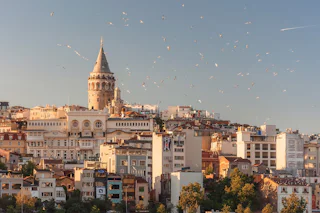
    Galata Tower was built in the mid-fourteenth century, in 1348, by the Genoese colony living on the northern shore of the Golden Horn. At the time it was called the Tower of Christ, and it formed the highest point of the walls surrounding Galata. With permission from Byzantium, the Genoese had founded a self-governing town here for trade. The tower was used for both observation and defence. The streets around it still follow the line of the walls today.

  2. The tower in the Ottoman period

    After the conquest of Istanbul, Galata came under Ottoman rule, and the tower was put to various uses. At one time it was a dungeon, at another a lookout post. Its longest-running role was as a fire watchtower. In Istanbul, where most houses were made of wood, fire was a major threat; when the watchmen in the tower spotted smoke, they alerted the city. The tower itself was damaged by fires in the eighteenth and nineteenth centuries and was repaired several times. It gained its present pointed conical roof during restoration in the 1960s.

  3. Hezarfen Ahmed Çelebi

    The story most associated with Galata Tower is the flight of Hezarfen Ahmed Çelebi. According to the traveller Evliya Çelebi, in the seventeenth century Ahmed Çelebi jumped from this tower with wings strapped to his arms and, helped by the wind, glided across the Bosphorus all the way to Üsküdar. As the story goes, the sultan both admired his courage and found it dangerous. No other source shows that the flight really took place; historians regard it as a legend. But when you step out onto the terrace and look towards Üsküdar, you'll understand why people have loved this story for centuries.

  4. On the terrace: the Historic Peninsula

    As you walk round the terrace, first look across the Golden Horn. The domes and minarets lined up on the hills form the skyline of the Historic Peninsula. The most prominent are the Süleymaniye Mosque and, beyond it, Hagia Sophia and the Blue Mosque; Topkapı Palace sits among the trees at Sarayburnu. The bridge over the Golden Horn is the Galata Bridge; imagine that the water beneath it was the city's busiest harbour for centuries. This view explains at a glance why the city grew between two shores.

  5. On the terrace: the Bosphorus and Üsküdar

    Move to the other side of the terrace. Where the Golden Horn opens into the sea, the Bosphorus begins. On the far shore, on the Asian side, you can see Üsküdar, and on a tiny islet in the middle of the sea stands the Maiden's Tower. Ships pass constantly between the Black Sea and the Sea of Marmara. Below, steep streets run down from the foot of the tower towards the sea, to Karaköy. In the nineteenth century, with their banks, embassies and shops, Galata and Beyoğlu were the city's most cosmopolitan district; you can still see buildings from that period in the surrounding streets.

  6. On your way down

    The tower reopened as a museum after restoration in 2020. The inner floors house an exhibition on the history of the tower and of Galata; don't forget to stop at these floors on your way down. The square in front of the tower and the surrounding streets are also worth a stroll. From here you can walk down to Karaköy and take a ferry across, or head up to İstiklal Avenue. The terrace is busier towards sunset; mornings are usually quieter.

Listen
3

Maiden's Tower

Üsküdar

Hours
around 09:00–18:00
Kapalı günler
Her gün açık
Kuyruk
Kapıda ortalama 25 dk, biletle yaklaşık 5 dk
Sign in
Kız Kulesi · yol tarifi (41.02110, 29.00410)

İpucu: Kuleye Üsküdar ya da Karaköy'den kalkan teknelerle gidilir; hava kötüyse seferler iptal olabilir.

4

Topkapı Palace

Sultanahmet

Hours
around 09:00–17:00 · closed Tuesdays
Kapalı günler
Tuesday
Kuyruk
Kapıda ortalama 35 dk, biletle yaklaşık 5 dk
Sign in
Topkapı Sarayı · yol tarifi (41.01150, 28.98340)

İpucu: Salı günleri kapalı. Harem ayrı bilettir. Bütün avlular için en az üç saat ayır.

Sesli rehber: Topkapı Sarayı · yaklaşık 5 dk

Through four courtyards, we'll follow how the palace closes in on itself from the outside in. The palace is closed on Tuesdays.

  1. The Imperial Gate and the First Courtyard

    You've entered the palace through the Imperial Gate, the Bab-ı Hümayun. Sultan Mehmed the Conqueror began building Topkapı Palace a few years after the conquest of Istanbul, and it was completed towards the end of the fifteenth century. For about four hundred years it was both the home of the Ottoman sultans and the administrative centre of the state. This first courtyard was the busiest and most open part of the palace; ordinary people could come in here too. The red-brick building on your left is Hagia Irene. This church from the Byzantine period was used for a long time under the Ottomans as an arms and ammunition store.

  2. The Middle Gate: access is restricted beyond this point

    The twin-towered gate in front of you is the Babüsselam, the Middle Gate. Beyond this gate, the palace was closed to ordinary visitors. It is said that no one but the sultan could ride through this gate on horseback; even viziers dismounted here. The second courtyard was known for its silence. Tree-lined paths mark the routes to different corners of the courtyard: the kitchens on the right, the area where state affairs were discussed on the left, and ahead, the gate to the sultan's private world. Pause for a moment and look at the layout of the courtyard: everything is arranged to show who could go how far.

  3. The Imperial Council and the Tower of Justice

    On the left, the domed buildings are the Divan-ı Hümayun, the Imperial Council. The state's most important decisions were discussed here at meetings attended by the viziers. High up on the wall you'll see a small latticed window. It is said that the sultan could listen to the discussions from behind this window without attending the meeting. For the viziers the meaning was clear: the sultan could be there at any moment. The tower rising just above the council hall is the Tower of Justice. It is the highest point of the palace and can be seen from many parts of the city. Its name is no accident: it was regarded as a symbol of the state's duty to uphold justice.

  4. The palace kitchens

    The long row of buildings on the right is the palace kitchens. Look at the line of chimneys: food was cooked here every day for thousands of people. The kitchens were rebuilt in Mimar Sinan's time after a fire in the sixteenth century. Today this section displays the palace's porcelain collection. Made up of Chinese and Japanese porcelain, it is considered one of the richest in the world. It is also said that some plates were believed to reveal poison; this was a belief, but it goes some way to explaining why the collection grew so large.

  5. The Harem

    The Harem was where the sultan's family lived. The sultan's mother, the valide sultan, lived here along with his wives, children and those who served them. Made up of hundreds of rooms, the Harem grew with additions over the centuries, which is why its corridors connect like a labyrinth. Among its most impressive sections are the apartments of the valide sultan and the great hall where ceremonies were held, the Hünkâr Sofası. On the tiled walls you can see the tastes of different centuries. The Harem requires a separate ticket; if your ticket includes the Harem, just show your QR code to the attendant at the entrance.

  6. The Gate of Felicity and the Audience Chamber

    The Babüssaade, the Gate of Felicity, was the entrance to the sultan's private world. During religious holiday ceremonies, the sultan's throne was set up in front of this gate. The small building you see once you pass through the gate is the Audience Chamber. Here the sultan received foreign envoys and the state's dignitaries. Before reaching it, envoys passed one by one through the courtyards, the gates and the silent waiting. This whole arrangement was designed to convey the greatness of the state from the very gate. Around this courtyard are the sections of the Enderun, where young men raised in the palace were educated.

  7. The Treasury and the Sacred Relics

    The Treasury is the most visited part of the palace. On display here are the eighty-six-carat Spoonmaker's Diamond and the Topkapı Dagger with its three large emeralds. The dagger was made in the eighteenth century as a gift for the Persian ruler Nader Shah. While the envoys were on their way, news came that Nader Shah had been killed, and the dagger returned to the palace. In the nearby Chamber of the Sacred Relics, objects regarded as holy in the Islamic world are kept. In this section, you need to stay quiet and follow the photography rules.

  8. The Fourth Courtyard and the view

    The last courtyard is the most private part of the palace, surrounded by gardens. The pavilions here were where the sultans relaxed. The Revan Pavilion and the Baghdad Pavilion were built to commemorate Murad IV's eastern campaigns. With their tiles and mother-of-pearl inlaid doors, they are among the finest examples of classical Ottoman decoration. From the marble terrace, look out over the Golden Horn and the mouth of the Bosphorus: the sultans watched the city and the sea from here. The palace was used until the move to Dolmabahçe in the mid-nineteenth century, and became a museum in 1924. It's a fine place to end your visit.

Listen
5

Basilica Cistern

Sultanahmet

Hours
Daily · open until late in the evening
Kapalı günler
Her gün açık
Kuyruk
Kapıda ortalama 65 dk, biletle yaklaşık 5 dk
Sign in
Yerebatan Sarnıcı · yol tarifi (41.00840, 28.97790)

İpucu: İçerisi serin ve loştur; zemin yer yer ıslak olabilir. İki Medusa başı sarnıcın sol arka köşesindedir.

Sesli rehber: Yerebatan Sarnıcı · yaklaşık 4 dk

We'll walk in the dark, a few metres below the street. Once your eyes adjust, the columns will emerge one by one.

  1. At the foot of the stairs

    You've come down the stairs and are now inside a fifteen-hundred-year-old water reservoir. The Basilica Cistern was built in the sixth century under Emperor Justinian I. It takes its name from a great basilica that stood above it. Locals called it the Sunken Palace; walk among the columns and you'll see why. The cistern supplied water to the nearby Great Palace and the surrounding area. Water was carried by aqueducts from sources outside the city and collected here. In times of siege or drought, cisterns like this one kept the city alive.

  2. A forest of columns

    Look at the columns stretching out in front of you. The cistern has three hundred and thirty-six columns, each about nine metres high, in twelve rows of twenty-eight. Most of the columns are marble, but their capitals don't match. That's because the builders used pieces brought from older buildings rather than carving new columns. So here you'll see capitals of different styles side by side. The brick vaults of the ceiling rest on the columns. Notice how your voice echoes as you walk: this place was never meant for visitors, but for storing water in silence.

  3. The forgotten cistern

    In the Ottoman period, the city's water needs were met mainly by running-water systems and fountains, so the cistern was gradually forgotten. In the sixteenth century, the French scholar Petrus Gyllius, who came to Istanbul to trace its ancient buildings, found this cistern. According to his account, people in the neighbourhood lowered buckets through holes in their basements to draw water, and even caught fish. No one fully realised that such a vast structure lay beneath them. Gyllius took a small boat among the columns and wrote down what he saw. His account plays a big part in the cistern's fame today.

  4. The weeping column

    Beside the walkway, you'll see a column with a shaft unlike the others. It is carved with motifs that look like eyes or teardrops, and it is always damp. That's why locals call it the Weeping Column or the Peacock-Eyed Column. Similar motifs appear on columns from one of the city's ancient forums, and this column is thought to have come from there. It is one of the best examples of how the cistern's builders reused pieces of older buildings.

  5. The Medusa heads

    At the far end of the cistern, two Medusa heads carved in stone sit beneath two columns. One is placed on its side, the other upside down. In mythology, Medusa turned anyone who looked at her to stone, and in antiquity she was believed to ward off evil. No one knows where these heads came from. There are many stories about why they were placed sideways and upside down, but the most plausible explanation is quite simple: the builders used these blocks as bases to bring the columns to the right height and positioned them however they fitted best.

  6. The cistern today

    The cistern reopened to visitors in 2022 after extensive restoration that began in 2017. Earthquake strengthening and new walkways were part of the work. Today the lighting is designed to highlight the columns and the surface of the water, and art installations are sometimes shown in the cistern. The cistern has also appeared in films, the best known being a 1963 James Bond film. Take one more look back as you leave: this darkness is the darkness that stored the city's water for fifteen hundred years.

Listen

Saatler ve kapalı günler mekânların duyurularına göre değişebilir; ziyaretten önce bilet sayfasındaki güncel bilgiye bak. Kitapçık 23 October 2026 tarihinde hazırlandı.