


Ephesus Ancient City audio guide
We'll walk Ephesus from the upper entrance downhill, along its marble streets. There's little shade, so bring your hat and water.
- 1The story of the city
Ephesus is one of the largest ancient cities in Anatolia. The city moved several times over its history, because as the sea retreated, the harbour moved further away. The city you're exploring today is largely the one refounded in the Hellenistic period by Lysimachus, one of Alexander the Great's generals. In the Roman period, Ephesus became one of the most important cities in the province of Asia. Most of the buildings you'll see date from that period. Ephesus was added to the UNESCO World Heritage List in 2015.
- 2The Odeon and the civic area
The small theatre-shaped building near the upper entrance is the Odeon. It is thought to have been used as the meeting place of the city council or for concerts. The surrounding area was the city's civic centre, where officials and leading citizens gathered. The rows of columns you see around you once supported covered walkways. Looking down from here, you'll see the city sloping towards the sea; our walk will also head this way, downhill.
- 3Curetes Street
You're now on Curetes Street, one of the city's most famous streets. This marble-paved street links the upper city to the great buildings below. Fountains, monuments and shops once lined the way. On the right, the elegant building with a woman's head on its arch is the Temple of Hadrian, built in the second century in honour of Emperor Hadrian. A little further on are the city's public latrines, with marble seats lined up side by side. In the ancient world, these were also places for conversation.
- 4The Terrace Houses
Under the protective roof on the slope beside the street are the Terrace Houses. These are houses built in tiers against the hillside, where the wealthy families of Ephesus lived. Because they lay buried for centuries, the frescoes on the walls and the mosaics on the floors are remarkably well preserved. In some rooms you'll see colourful wall decoration, in others marble cladding. The walkways pass above the houses, and you can watch the excavation and restoration work still going on below. Your ticket covers entry to the Terrace Houses.
- 5The Library of Celsus
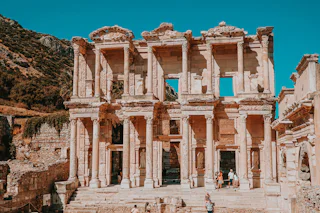
In front of you is the most photographed building in Ephesus: the Library of Celsus. The library was built in the early second century by his son in memory of Celsus, governor of the province of Asia. Celsus's tomb lies beneath the building. The façade was re-erected in the 1970s by reassembling the pieces found on the ground. The four female statues on the front represent wisdom, virtue, thought and knowledge; those here are copies, and the originals are in a museum in Vienna. The large gate beside the library opens onto the city's commercial agora.
- 6The Great Theatre and the lost harbour
The last stop is the Great Theatre, carved into the mountainside. It is thought to have held around twenty-five thousand spectators. The theatre is known as the scene of the uproar that followed Paul's preaching, described in the Acts of the Apostles in the Bible. The broad street running from the front of the theatre towards the sea once led down to the harbour. But silt carried by the river gradually filled the harbour, and today the sea is several kilometres away. This was the main reason for the city's decline. After Ephesus, in Selçuk, you can also see the only standing column of the Temple of Artemis, one of the Seven Wonders of the World.