




Historian's route
1 tickets€29
Source: Prof. Dr. İlber Ortaylı (1947–2026)
İlber Ortaylı's Istanbul walk, in two days
1 ticketed stopsOpen the route
A day in the Commander-in-Chief Historical National Park, where the last great battle of the Turkish–Greek War was fought: the Victory Museum in Afyonkarahisar; Kocatepe, from where Mustafa Kemal Paşa watched the offensive on the morning of 26 August 1922; then the Great Offensive, Zafertepe and Dumlupınar martyrs' cemeteries. You travel between the stops by car (≈ 100 km in total).
Mustafa Kemal Atatürk (1881–1938)His life, the War of Independence, the Republic and AnıtkabirRead →The area where the last battles of the Turkish–Greek War (1919–1922) were fought was declared the Commander-in-Chief (Başkomutan) Historical National Park on 8 November 1981. Spreading across the provinces of Afyonkarahisar, Kütahya and Uşak, the park is a place of remembrance with its museums, memorials and martyrs' cemeteries.
The Great Offensive began with an artillery barrage on the morning of 26 August 1922. Mustafa Kemal Paşa watched the operation from the observation post at Kocatepe together with Fevzi (Çakmak) Paşa and İsmet (İnönü) Paşa; it is said that thick fog delayed the opening of fire by half an hour.
The battle ended on 30 August around Zafertepe, with fighting directed personally by the Commander-in-Chief, and the Greek army withdrew. Today 30 August is celebrated as Victory Day; yet thousands of soldiers on both sides died in the battles.
At a ceremony in Dumlupınar on 30 August 1924, Mustafa Kemal Paşa laid the foundation stone of the Martyred Soldier Monument. Today, in the park's martyrs' cemeteries, you can read the ranks and home towns of the dead, one by one, on their headstones.
Remembrance and mourning (grief tourism) means visiting places people go to remember loss and share grief: martyrs' cemeteries, war cemeteries, monuments, historic cemeteries and museums that preserve the memory of disasters. Every place here is an officially open memorial site; we don't include very recent tragedies that people are still grieving, or contested sites. At these places, someone may still be remembering a loved one: keep quiet, don't pose for photos, and don't photograph anyone praying.
Start: central Afyonkarahisar, Millî Birlik Caddesi · stay 45 min
The building used as headquarters by Mustafa Kemal Paşa and his commanders after Afyonkarahisar was retaken on 27 August 1922. The rooms display belongings of Mustafa Kemal, İsmet İnönü, Fevzi Çakmak and other commanders of the time.
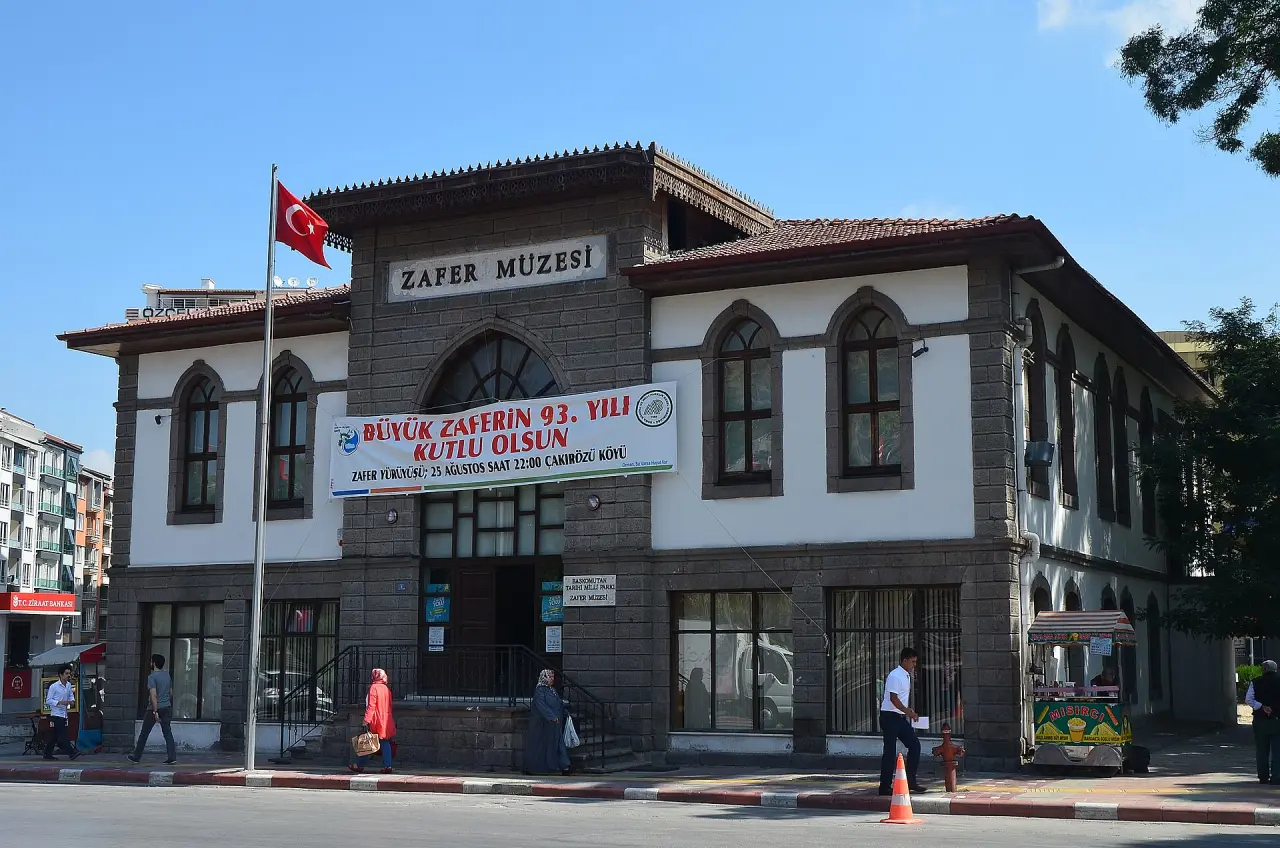
It is reported to have reopened in 2024 after restoration; check whether it is open and its hours before you go. (Photo: 2015.)
≈ 30 min by car (≈ 20 km) south-west · stay 60 min
The hill Mustafa Kemal Pasha reached on the evening of 25 August 1922 and from which he watched the offensive begin on the morning of 26 August. At the summit stand an Atatürk statue, cannons and inscriptions describing the offensive; the Kocatepe section of the park also has martyrs' cemeteries.
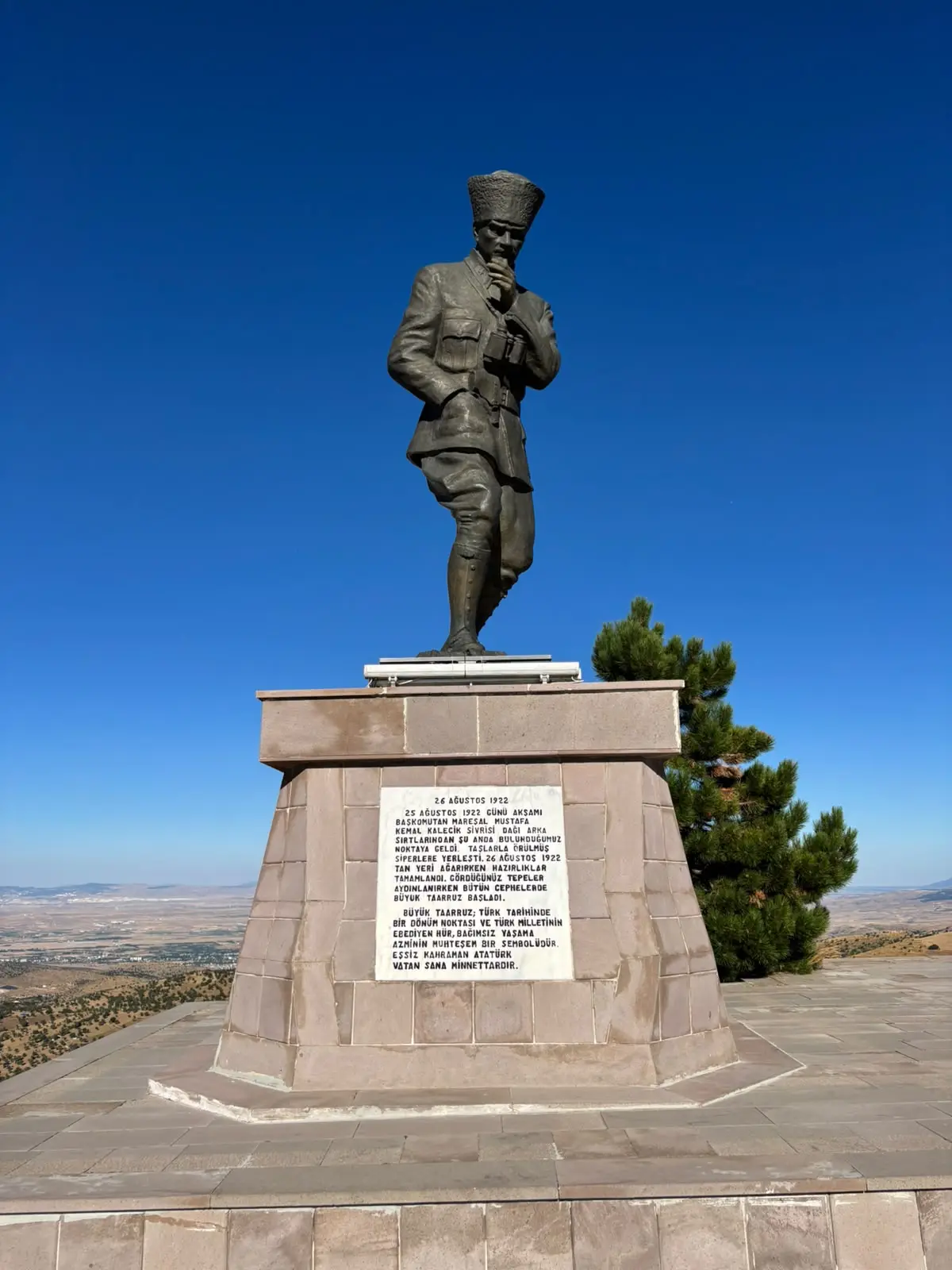
The last stretch to the summit is on foot; windy and without shade. There may be snow and ice in winter.
≈ 30 min by car (≈ 25 km) north-west · stay 40 min
The cemetery where the soldiers who died in the first days of the offensive lie; their ranks and home towns are written on the marble headstones. In the middle rises a statue of Mustafa Kemal Paşa, mid-stride with his hand raised to his chin.

Location: OSM and the photo's location data.
≈ 45 min by car (≈ 40 km) west, Zafertepeçalköy (Kütahya) · stay 40 min
The hill where Mustafa Kemal Paşa directed the Battle of the Commander-in-Chief on 30 August 1922. The memorial area has concrete monuments and panels describing the battle; the Martyred Standard-Bearer Mehmetçik Memorial is nearby.

Choose a place for lunch in advance; there are few facilities on the village roads. Location: the memorial marker on OSM.
≈ 20 min by car (≈ 15 km) south-west, Dumlupınar · stay 60 min
The park's largest memorial site: a long flight of steps climbs to the Martyred Soldier Monument on the hilltop, surrounded by headstones and a statue of a soldier carrying a wounded comrade. Mustafa Kemal Paşa laid the monument's foundation stone at a ceremony on 30 August 1924.

It gets very crowded on 30 August and roads may be closed; check the ceremony programme before you go.
≈ 2 h 15 min · fast ferry + bus · Day trip
Why here: The first Ottoman capital. The Green Mosque, the Grand Mosque and Koza Han make an easy day trip; we suggest it if you are staying in Istanbul for more than four days. Not part of this route.
Travellers who check in on this route can rate it. No one else can.
Be one of the first travellers to walk this route. If you have a question or a tip, share it with the community.
After walking the route you can rate it using the check-in in the app. Reviews go live after a short check.
Source: Prof. Dr. İlber Ortaylı (1947–2026)
Source: Prof. Dr. İlber Ortaylı (1947–2026)
